![]() |
| D&RGW #683, the only standard gauge Rio Grande steam engine known to survive is preserved at the Colorado Railroad Museum in Golden, Colorado. The first outdoor exhibit most encounter at the museum, the engine is quite popular with the young (and young at heart) who want to ring the engine's bell. Photo: Christopher J. May |
Monday, November 4, 2013
POTD - A New Way To See Things
It's been a while now since I've done some Photos of the Day, and it hasn't really been for lack of good photographs. I'm finding more, not less out there. Keep shooting and I'll keep posting!
Chris May takes today's Photo of the Day with this half-portrait of Rio Grande engine 683. For me, the vertical lines of the stack and horizontal lines of the top of the pilot combine with the half-circles of the headlight and boiler to make it interesting. While the foreground is almost completely monochrome and in focus, the background is awash with soft colors of every natural hue. The engine has been photographed by May "countless times" but this shot just occurred to him on the way to the car. Proof that "there's always a new way to see things..." ◊
Sunday, November 3, 2013
Product Review: Porcelain Herald
Like a lot of folks, I tend like a specific herald from my favorite railroad. But is it worth buying a version of it to keep? If so, how many are enough?
A railroad herald identifies the railroad company just like logos do today. They are a seal and a promise, if the railroad is run with precision and pride; a warning and a refusal if not. But for those who remember the railroads of yesterday, they're a way of recalling those memories, a symbol of what they miss and appreciate.
When shopping online, there are a lot of variables one can't really account for unless one knows the product or at least knows the retailer well enough to hazard a purchase. Everyone I know has at least one story of ordering something that just didn't turn out as advertised. I make use of product reviews now almost without exception. But in shopping for railroad gear, finding the reviews are sometimes futile and almost always don't tell you what you want to know. That's brings me to a very direct point. If you ever want to ask about a product I've reviewed or anything else, comment in and ask. I allow anonymous comments to make it easy for you. If nothing else, email me directly and I'll do my best to find it in my inbox and answer.
So, I like my railroad, and I wanted to add some personality to my home and possibly my future layout. A herald can do that. I also wanted to signal friends and acquaintances that might like the railroad as well. I kept my eyes peeled and, although I had found one at a museum, it was a particleboard back and I wanted something more durable.
In 2001, I took advantage of a last minute invitation Memorial Day weekend to drive with my then-5 year-old daughter to Durango to ride the Silverton train. Very good memories from that trip still warm my heart. The day before our trip, we hit the gift shop and I found the Rio Grande Main Line Thru the Rockies sign hanging above the checkout. It surprises me to admit it, but it meant something to be able to buy that sign in the same building that had doubtless held General Palmer and so many other railroad men and women over the years.
I was surprised when I took it down to feel how heavy it was. The sign was not aluminum or wood. It was a gauge of steel much heavier than the ventilation ducts and other materials I'd handled over the years. The grommets were mounted in holes that would accommodate most fasteners, and the porcelain meant to me that it would last for years without worrying about fading ink from sunlight or expanding particle board from water. It's held up this far and will likely outlast my lifetime, as far as I can tell. If you're a fan of a special railroad, it's worth showing off a little. You never know when you'll meet another railfan!
I wrote a review a year ago at Schrader's railroadcatalog.com site. It isn't the only place you can get the same porcelain herald, but it's one place I trust. My only wish is to be able to get more than one size. Between 150 - 200% larger would fit nicely as a centerpiece to some photographs.
As far as how many are enough, I know I won't get sick of looking at it anytime soon. So as many as you--or your family--can stand!◊
A railroad herald identifies the railroad company just like logos do today. They are a seal and a promise, if the railroad is run with precision and pride; a warning and a refusal if not. But for those who remember the railroads of yesterday, they're a way of recalling those memories, a symbol of what they miss and appreciate.
When shopping online, there are a lot of variables one can't really account for unless one knows the product or at least knows the retailer well enough to hazard a purchase. Everyone I know has at least one story of ordering something that just didn't turn out as advertised. I make use of product reviews now almost without exception. But in shopping for railroad gear, finding the reviews are sometimes futile and almost always don't tell you what you want to know. That's brings me to a very direct point. If you ever want to ask about a product I've reviewed or anything else, comment in and ask. I allow anonymous comments to make it easy for you. If nothing else, email me directly and I'll do my best to find it in my inbox and answer.
So, I like my railroad, and I wanted to add some personality to my home and possibly my future layout. A herald can do that. I also wanted to signal friends and acquaintances that might like the railroad as well. I kept my eyes peeled and, although I had found one at a museum, it was a particleboard back and I wanted something more durable.
In 2001, I took advantage of a last minute invitation Memorial Day weekend to drive with my then-5 year-old daughter to Durango to ride the Silverton train. Very good memories from that trip still warm my heart. The day before our trip, we hit the gift shop and I found the Rio Grande Main Line Thru the Rockies sign hanging above the checkout. It surprises me to admit it, but it meant something to be able to buy that sign in the same building that had doubtless held General Palmer and so many other railroad men and women over the years.I was surprised when I took it down to feel how heavy it was. The sign was not aluminum or wood. It was a gauge of steel much heavier than the ventilation ducts and other materials I'd handled over the years. The grommets were mounted in holes that would accommodate most fasteners, and the porcelain meant to me that it would last for years without worrying about fading ink from sunlight or expanding particle board from water. It's held up this far and will likely outlast my lifetime, as far as I can tell. If you're a fan of a special railroad, it's worth showing off a little. You never know when you'll meet another railfan!
I wrote a review a year ago at Schrader's railroadcatalog.com site. It isn't the only place you can get the same porcelain herald, but it's one place I trust. My only wish is to be able to get more than one size. Between 150 - 200% larger would fit nicely as a centerpiece to some photographs.
As far as how many are enough, I know I won't get sick of looking at it anytime soon. So as many as you--or your family--can stand!◊
Thursday, October 31, 2013
Video Vault: Colorado Steam Mecca
Time to blow some dust off this video from the crypt vault. While I've not seen this recently, I have no doubt in my mind that this video used to be available on VHS, and trained eyes will be able to spot significant differences between the railroads captured on this DVD and their present state (like #346), which are improvements, for the most part.
Seeing the Colorado Railroad Museum as it was in the 80s brought back some memories from my visits and volunteer work. For those with the ability, volunteering there can change your world.◊
Tuesday, October 29, 2013
Colorado Railroad Museum Vlog Debuts, Builds Following
I just found something very encouraging being done at the Colorado Railroad Museum. For many, many years, the museum has produced a periodical called the Iron Horse News, started by their founder, Robert W. Richardson. They now have turned it into a video blog (Vlog) or video magazine. Take a look at the latest [YT] to see the improvement, then visit their channel on YouTube and subscribe to the museum to get new updates!
I was gratified to hear that Rio Grande K-37 Mikado #491 is finally, officially part of the museum. Long has the lonely example of the fabled narrow gauge 2-8-2 class suffered like her sisters from the weather while the smaller, lighter, and more versatile K-36 engines (480 - 489) remain in top condition because of their usefulness to narrow gauge circle, heritage railroads like the Cumbres & Toltec Scenic Railroad. The heavy, rigid frame of the K-37 engines tend to put more wear and tear on the bridges and curves. While the 491 is not slated for full restoration, this change in ownership was the first step in that direction. Here's hoping!
Great work, Donald and all the staff at the museum, especially the volunteers!◊
I was gratified to hear that Rio Grande K-37 Mikado #491 is finally, officially part of the museum. Long has the lonely example of the fabled narrow gauge 2-8-2 class suffered like her sisters from the weather while the smaller, lighter, and more versatile K-36 engines (480 - 489) remain in top condition because of their usefulness to narrow gauge circle, heritage railroads like the Cumbres & Toltec Scenic Railroad. The heavy, rigid frame of the K-37 engines tend to put more wear and tear on the bridges and curves. While the 491 is not slated for full restoration, this change in ownership was the first step in that direction. Here's hoping!
Great work, Donald and all the staff at the museum, especially the volunteers!◊
Monday, October 28, 2013
BNSF Heritage Hoppers
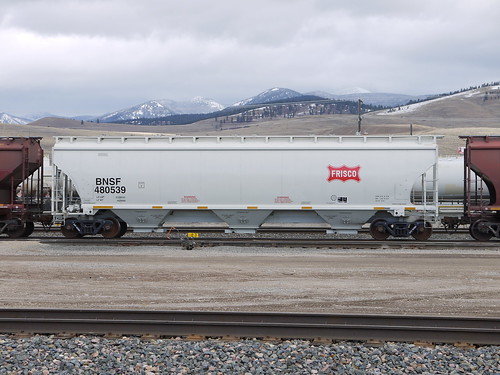
Heritage fleets just keep on getting bigger. This year, BNSF has finally gotten with the program and produced a half-hearted "heritage hopper" harem.

Photo by John Csoka
It's almost as if they looked at UP and NS and said, "Oh, alright. Here. But don't expect us to paint them snazzy colors or anything."
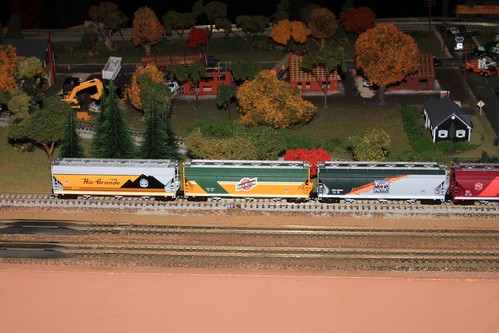
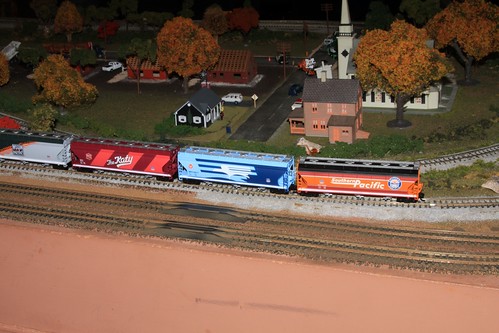
What? You mean like these?


Both photos by Keith Schmidt.
The models were created by MTH, but probably could be adapted by the prototypic Union Pacific. A look at some concepts from the model railroading world might just show us what's possible for BNSF to try, if they're ever so inclined. In particular, Lionel (yes, that Lionel, 3 rails and all) designed some passable heritage designs that would catch anyone's eye.
Burlington 1848
Burlington Northern 1970
Frisco 1876
Great Northern 1889
Northern Pacific 1870
Santa Fe 1996
Above 6 photos Lionel.com LLC. (Catalog)
As with Union Pacific, the road numbers of the locomotives signify a year. In this case, it's based on the year the railroad started (save Santa Fe), rather than the year they joined the system. While there are no prototypical or "real" engines for these models (at least, not yet), I have to admit that when the design is scaled up, they look pretty sharp. To wit:
Which is your favorite? What about a Colorado & Southern locomotive? Do you think UP should start painting heritage hoppers based on the success of the Heritage Fleet?◊

Photo by John Csoka
It's almost as if they looked at UP and NS and said, "Oh, alright. Here. But don't expect us to paint them snazzy colors or anything."
What? You mean like these?


Both photos by Keith Schmidt.
The models were created by MTH, but probably could be adapted by the prototypic Union Pacific. A look at some concepts from the model railroading world might just show us what's possible for BNSF to try, if they're ever so inclined. In particular, Lionel (yes, that Lionel, 3 rails and all) designed some passable heritage designs that would catch anyone's eye.
Burlington 1848
Burlington Northern 1970
Frisco 1876
Great Northern 1889
Northern Pacific 1870
Santa Fe 1996
Above 6 photos Lionel.com LLC. (Catalog)
As with Union Pacific, the road numbers of the locomotives signify a year. In this case, it's based on the year the railroad started (save Santa Fe), rather than the year they joined the system. While there are no prototypical or "real" engines for these models (at least, not yet), I have to admit that when the design is scaled up, they look pretty sharp. To wit:
![]() |
![]() |
Which is your favorite? What about a Colorado & Southern locomotive? Do you think UP should start painting heritage hoppers based on the success of the Heritage Fleet?◊
Tags:
Atchison Topeka and Santa Fe,
BNSF,
Burlington Northern,
Colorado and Southern,
history,
Locomotive,
Model and Scale Railroads,
Opinion,
public relations,
Union Pacific,
UP 1989
Friday, October 25, 2013
Final Departure For Robert LeMassena
![]() |
| Robert LeMassena photo by Matt Isaacks |
Earlier this month, Nathan Holmes of DRGW.net had this to say,
Bob left us a great deal of his amassed knowledge through his books - the most notable to most Rio Grande fans being "Rio Grande... to the Pacific!" RGTTP is an invaluable piece of work, and is still my go-to reference for the Grande's often convoluted historical timeline.Holmes also speculated that the Colorado Railroad Museum will have a memorial event of some kind in the near future.
Colorado and railroad historians have lost a true "steam buff" in Robert LeMassena. From the Delaware, Lackawanna & Western yard in East Orange, New Jersey in his youth to the high mountain passes and thundering articulated locomotives in the Colorado high country and beyond, his long life was spent in the pursuit of his passion for railroads and the engines that powered them. Few were so lucky as he in this regard. I wish him Godspeed on his final departure.◊
Saturday, September 14, 2013
Colorado Flooding: First Looks At the Devastation
"The problem with this event is that it affects every road of the county," "It’s a sinking feeling to know that if someone calls 9-1-1, we’re not going to be able to reach them," and "We don't know what we don't know," said by Joe Pelle, Boulder County Sheriff of one of the affected areas. These are words you don't want to hear when you have loved ones in the path of destruction.
Loveland, Ft. Collins, Greeley, Lyons, and other smaller towns are severely impacted by the flooding. The Big Thompson River, the same that flash flooded in 1976 and killed 143 people, has destroyed everything near the narrows of the canyon. Other portions along the river are not as bad, but portions of missing highway are isolating more people where it's the only way out.
In Longmont, portions of railroad served as levy and dike to protect some neighborhoods, while other sections of railroad (and neighborhoods) lay completely underwater. See the raw footage:
If the weather cooperates, I'm speculating the damage to railroad infrastructure and the counties' roads will take months to fully repair. I hope, for Colorado's sake, that I'm wrong. That's not nearly as bad as the potential cost in lives, which stands at 3 but could definitely climb in the next few days and weeks. I'm praying the break in the weather holds.◊
Loveland, Ft. Collins, Greeley, Lyons, and other smaller towns are severely impacted by the flooding. The Big Thompson River, the same that flash flooded in 1976 and killed 143 people, has destroyed everything near the narrows of the canyon. Other portions along the river are not as bad, but portions of missing highway are isolating more people where it's the only way out.
In Longmont, portions of railroad served as levy and dike to protect some neighborhoods, while other sections of railroad (and neighborhoods) lay completely underwater. See the raw footage:
If the weather cooperates, I'm speculating the damage to railroad infrastructure and the counties' roads will take months to fully repair. I hope, for Colorado's sake, that I'm wrong. That's not nearly as bad as the potential cost in lives, which stands at 3 but could definitely climb in the next few days and weeks. I'm praying the break in the weather holds.◊
Tags:
destruction,
Flood and Mud,
MOW,
service disruption
Friday, September 13, 2013
Front Range Flooding Affects BNSF, UP
There have been widespread road closures due to flooding, including I-25 in both directions from Denver to the Wyoming state line. In my experience, any disruption that affects a road will affect a railroad to some extent, with an emphasis on proximity to the source. This holds true for this week's craziness. Greeley--I've just learned--is inundated.
Erosion fascinates me. Water under pressure does amazing things. Canyons thought to form over millennia can happen within days, as witnessed on Mt. Saint Helens, given the right pressure, viscosity and debris. Dams thought secure can overtop and within minutes begin to tear open. And as witnessed this week on network TV, roads can be eaten out from under cars while people sit inside unaware and in grave danger.
Considering the weight of locomotives, cars and cargo, imagine what a pair of rails need to stay solid. Railroads are only as good as the ballast beneath them. Still, there's something else I noticed today.
When you look at the state's railroads, perhaps the most densely developed railroad corridor is the northern Front Range, the piedmont between Denver and Wyoming, and ground zero for our disaster. Clearly, the worst place to have a flood in Colorado--as far as rail is concerned--is right there. It's development fueled the 19th and 20th century economies for Colorado and the rest of the mountain states. History runs thick. This area saw the first rail connection for Denver and the then-Territory of Colorado with the rest of the nation on the Pacific railroad. These rails served the introduction for thousands of travelers making their way to Colorado for a holiday or a new life to settle as a pioneer.
Ironically, Amtrak's Pioneer traveled the same rails, but in the opposite direction from Denver northward to Seattle until the early 90s. Since then, only the California Zephyr continues to grace Denver's presence. While Amtrak hasn't issued any information regarding the status of the daily Zephyr, both Class I railroads in Colorado have issued statements.
BNSF issued a more detailed statement today regarding specific locations, saying,
You can bet the MOW gangs are going to have a time making the weak sections solid again.
Stay dry, folks! Hopefully, we've seen the worst of it.◊

Colorado's Woes Owed to Historic Rainfall
While Colorado has had occasional and rare stretches of showers and overcast skies, the rainfall this week has shattered records. In some places, over half a year's worth of rain fell in a few short days. No one I know can recall this kind of flooding ever happening here. Ever.Erosion fascinates me. Water under pressure does amazing things. Canyons thought to form over millennia can happen within days, as witnessed on Mt. Saint Helens, given the right pressure, viscosity and debris. Dams thought secure can overtop and within minutes begin to tear open. And as witnessed this week on network TV, roads can be eaten out from under cars while people sit inside unaware and in grave danger.
Considering the weight of locomotives, cars and cargo, imagine what a pair of rails need to stay solid. Railroads are only as good as the ballast beneath them. Still, there's something else I noticed today.
![]() |
| Colorado's cities (red) and railroads (dashed lines). Quick and ugly map created on nationalatlas.gov The northern half of the Front Range Urban Corridor is highlighted. |
Ironically, Amtrak's Pioneer traveled the same rails, but in the opposite direction from Denver northward to Seattle until the early 90s. Since then, only the California Zephyr continues to grace Denver's presence. While Amtrak hasn't issued any information regarding the status of the daily Zephyr, both Class I railroads in Colorado have issued statements.
Class I Railroads Affected
Union Pacific issued a statement yesterday regarding the impact of the storms, indicating a likely delay of 24 hours for the affected areas including Limon, Colorado Springs, Commerce City, Rolla and Greeley.BNSF issued a more detailed statement today regarding specific locations, saying,
The track at South Colorado Springs, Colorado is out of service due to washout. South Colorado Springs, Colorado is approximately 72 miles south of Denver, Colorado. The main track is expected to return to service later this evening, Friday, September 13, 2013.
The tracks at Boulder, Colorado and Loveland, Colorado are out of service due to multiple washouts. Boulder, Colorado is approximately 30 miles northwest of Denver, Colorado, and Loveland, Colorado is approximately 52 miles north of Denver, Colorado. No estimated return to service has been issued yet. Customers between Broomfield, Colorado, and Dixon, Colorado, will not be serviced until track is restored.
You can bet the MOW gangs are going to have a time making the weak sections solid again.
Stay dry, folks! Hopefully, we've seen the worst of it.◊
Tags:
BNSF,
California Zephyr,
CDOT,
destruction,
Flood and Mud,
freight,
general transportation,
history,
Joint Line,
Moffat Route,
MOW,
passenger,
service disruption,
Union Pacific
Location:
Greeley, CO, USA
Thursday, September 12, 2013
Caterpillars Versus Aspen Fall Colors
| Fall colors on Kebler Pass 2012 Photo by Aakash sahai, CCL3.0 |
It's usually one or the other for my family when we go. Most years, anyway.
I've been hearing some disturbing rumors that the season will be severely affected or possibly killed outright in some regions like far southern Colorado and northern New Mexico by a rampaging herd of caterpillars. Tent worms or tent caterpillars apparently love to munch aspen leaves. As though the fires earlier this year and the perennial beetle kill in other parts of the state weren't enough, we now may have a total lack of foliage in some formerly picturesque spots.
Steam Train Videos has a shot of one of James Parfrey's latest trips shot earlier this 2013 season. It turns out the infestation was turning the tracks into a slippery ...well, if you care about insects, you probably shouldn't watch. I can't imagine what bird--except a Mudhen like 463--wouldn't mind growing fat on these things, especially after a train ...wounds so many of them. On the bright side, aspen leaves are good for salicylates, the key ingredient in aspirin, so when the train crushes one of the buggers, they might not feel pain ...at least not as much.
According to a family friend, folks are saying that the aspens can take this for a year or even two, but continued over-grazing by the Tent caterpillar could negatively affect the aspen stands in a permanent way. Let's hope they're wrong. I don't truly know how severe it is for this season or for every location, but a well-timed call to the Cumbres & Toltec or your specific railroad of choice may keep your fall trip from going bust.
For more, watch the video below. It's a bit alarmist, but like the guy says, time will tell.◊
Saturday, August 31, 2013
Railroading 101: Modern Freight Railroads
With no Bronco game :-[ this Labor Day weekend, there's more than enough time to take in a movie or an extra show. A few years ago, History channel turned out an episode about "Freight Trains." Although one or two minor errors slipped by--that I could tell, anyway--the 45 minute documentary does a more than passable job in explaining the basics of steam piston valves, diesel engine construction, freight cars, yards, and virtually every other aspect of modern railroading in America, including the demise of steam and FRED's elimination of the caboose. While there is nothing that ties into Colorado directly, there is plenty to keep even the casual viewer interested.
It was good to see Jim Boyd, former editor of Railfan & Railroad magazine and an accomplished author make an appearance in the episode. He was a great asset to railfans everywhere. He will be sorely missed.◊
Tags:
BNSF,
Railroading 101,
Union Pacific,
web videos
Sunday, August 25, 2013
Could I-25's Woes Be Improved By 2014?
Yes, says a Colorado Springs' Independent article about CDOT's desire to improve the I-25 corridor with a multimodal approach.
According to the article, since the demise of FREX last year under Colorado Springs' Mayor Steve Bach, the traffic on I-25 has gone from so-so to so-not-moving. Could CDOT assist with a regional solution? Under 2009's FASTER legislation, yes it can, but only if funding and state supporters jump on board.
Lest we believe CDOT's rail proponents exclusively, a northern Colorado CDOT official's gripe about fixing roads before rail can be heard clear from Fort Collins. Nevermind the subject's withering truck traffic load.
Thanks to the Colorado Rail Passenger Association for these links.◊
According to the article, since the demise of FREX last year under Colorado Springs' Mayor Steve Bach, the traffic on I-25 has gone from so-so to so-not-moving. Could CDOT assist with a regional solution? Under 2009's FASTER legislation, yes it can, but only if funding and state supporters jump on board.
Lest we believe CDOT's rail proponents exclusively, a northern Colorado CDOT official's gripe about fixing roads before rail can be heard clear from Fort Collins. Nevermind the subject's withering truck traffic load.
Thanks to the Colorado Rail Passenger Association for these links.◊
Tags:
CDOT,
Commuter Rail,
Off-rails,
Original Artwork
Friday, August 9, 2013
The Vanishing Rock Island - Colorado Springs Civic Leaders Steal Their Own City's Future
![]() |
| Gazette.com photo by Michael Ciaglo |
Claude Wiatrowski, Springs resident and author of Railroads of Colorado and Railroads Across North America wrote in a comment on the Gazette article,
This is part of the Rock Island railroad that once ran between downtown Colorado Springs and Chicago. Recently, the tracks have been intact as far as Limon. I think it is very short sighted that they were not saved at least as far as Falcon. With all the residential development in the Falcon area, this would have made the perfect commuter rail line, connecting a developing residential area to downtown. Instead we will add yet more lanes to Woodmen or Constitution.Indeed it would make the perfect commuter line! The entire north and east sides of Colorado Springs residents would benefit. Instead of routing traffic to US 24 and forcing more commuters to sit in their cars and travel a longer route, Colorado Springs could keep this line and implement light rail or commuter rail at a fraction of what Denver would have to pay for right-of-way acquisition. What are the civic leaders of Colorado Springs thinking? Is it really time to eat the seed you saved for planting?
If we have to take up the tracks, stockpile them at the Springs Trolley museum for protection and eventual restoration. Then pass city legislation preserving the entirety of the route for future transit. If Colorado Springs truly wants a good future, it's elected leaders shall preserve and protect it today.◊
Tags:
Commuter Rail,
Light Rail,
Preservation,
Rock Island
Location:
Roswell, Colorado Springs, CO 80907, USA
Thursday, August 8, 2013
This Weekend, History of Denver's Transit Past At Fed Center
This weekend, folks near the Denver Federal Center in Lakewood have an annual opportunity to connect with other railroads and a unique part of history. Lee Ryan explains:
Sounds like fun, Lee! Best of all, it's free!◊
Saturday, August 10th is the once a year roll-out for Denver & Intermountain R.R. Co. Interurban trolley #25 and I will be on board as an operator throughout the day.
This Interurban trolley was built in Denver, CO in 1911 by the Woeber Carriage Co. Being an Interurban trolley it had a top speed of 70mph. It is the only original Denver trolley lo still in existence. It was pulled out of the Colorado Railroad Museum by the Rocky Mountain RR Club and moved to the Denver Federal Center for complete restoration. After many, many, many volunteer hours, and hundreds of thousands of dollars in donations, this trolley has been restored to its original 1911 appearance. The trolley is just about finished with only some minor things to tinker with as time permits. It has been 20+ years of hard dedicated work to get this far. For now the trolley is operational on a 1/4 mile section of track at the Denver Federal Center and is stored inside on Federal Center property. It is interesting to note that the track it operates on today is the same track it operated on over 60 years ago.
The #25 is now owned by the City of Lakewood, CO. Operators are provided by the Denver Tramway Heritage Society which owns and operates breezer trolley replica #1977 along the South Platte River.
Saturday's event is open to the public from 10am-2pm. Rides on the #25 are free, donations are welcome. The Denver Federal Center is located at 6th Ave. & Kipling St. in Lakewood, Colorado. Enter at gate #1 off of Kipling St. through the Visitor Gate. Everyone entering the Federal Center property will have to show an I.D. to the guard. Once inside, follow the road to the stop sign and turn right. Signs will point you to the trolley event.
We hope you can join us for a trip back in time on the Denver & Intermountain Interurban trolley #25!
Sounds like fun, Lee! Best of all, it's free!◊
Wednesday, July 31, 2013
POTD: Blending into Plain Sight
![]() |
| Photo: Frank Keller |
On the cool morning of October 24, 2010, the bright orange of this BNSF coal train blends in with the autumn brush colors as it descends from Monument below the watchful gaze of the Rampart Range and the northern reaches of the Air Force Academy grounds along the Rio Grande right-of-way. The other half of the Joint Line, the Santa Fe right-of-way, is in the immediate foreground, abandoned 41 years ago, with a handful of pilings and a single bent showing the former trestle site for what it is.◊
Tags:
BNSF,
coal,
Fall Colors,
Joint Line,
POTD
Location:
Monument, CO, USA
Tuesday, July 30, 2013
POTD: History Running Late
![]() |
| Photo: Mike Danneman |
Popping in and out of sunlight, the California Zephyr makes it's way through Rocky in the early evening along the Front Range. Nothing would be amiss if this were train 6, the eastbound heading for Denver. Unfortunately, this is train 5, the westbound heading up to Granby and Glenwood Springs at 6:40 PM on June 25, 2011. Amtrak Phase III heritage unit #145 rides point as it scrounges the rails for spare minutes to make up a schedule that is 10 hours late, according to photographer Mike Danneman, who has taken POTD for both yesterday and today. Amtrak #145 is one of five units painted in a special heritage paint scheme celebrating Amtrak and its history of 40 years from 1971 to 2011. History, at least today, is running late.◊
Tags:
Amtrak,
California Zephyr,
Moffat Route,
POTD
Location:
Rocky, CO, USA
Monday, July 29, 2013
POTD: Tunnel Motor at Minturn
![]() |
| Photo: Mike Danneman |
Today's Photo of the Day comes from Mike Danneman. His photo, titled Tunnel Motor at Minturn, captured Rio Grande SD40T-2 #5398 at the head of a westbound coal train waiting for a new crew in Minturn before departing for Dotsero, Glenwood Springs and points west. Mr. Danneman's choice of including the rail for the foreground is no mistake. The top of the rail is where everything happens for this train and the entire Rio Grande Railroad! The more I look at this photo, the more I like it. That's a good sign!◊
Tags:
coal,
Denver and Rio Grande Western,
Minturn,
POTD,
SD40T-2
Location:
Minturn, Colorado
Sunday, July 28, 2013
''Tell My Wife I Died Thinking Of Her''
Over a century ago, the tale of Denver, South Park & Pacific engineer William Westall was a popular story and eventually people retold often enough that it entered into folklore. The common version is simple but memorable enough:
While typically devoid of details, the folk tale is nonetheless true. It might have been lost forever to history, if it weren't for a cryptic monument and a tourist's curiosity. The full story of the monument, the tourist and the engineer who saved 450 passengers from death is recorded by Milly Roeder in an article, The Story of Billy Westall and the Westall Monument, originally published in 1998 by the Jefferson County Historical Commission.
The next year after Westall's death, the DSP&P was absorbed in the 1899 merger creating the Colorado & Southern. That same year, the monument was placed along the right of way near the spot of the derailed engine. For the next century, it stood, surviving not only the C&S, but the Burlington, BN and all the people who ever knew Westall. The monument itself, according to the 14 year-old article, was in peril of falling into the river.
Enter a group of students, the National Junior Honor Society from West Jefferson Middle School in Conifer. Over the past year and a half, they've been planning and working to restore the monument. Notably, the way they're going about it seems to be working. They've involved a number of folks, like Denver Water's Neil Sperandeo, and historic groups, including Colorado Preservation Inc. and the Denver South Park & Pacific Historic Society. As of this month, work has progressed to the point that they have a new site picked out and could use some grant money to restore the monument to its new location. Those interested in getting involved or donating to the project should e-mail Mr. Frank Reetz of West Jefferson Middle School.
All this cooperation and learning is happening because of history, preservation, and adults who are willing to get involved. Certainly, a lot of good is coming out of the tragic death of an engineer.◊
- A train filled with people was headed down the track
- Rounding a curve, the engineer saw an alarming sight. The track was obstructed with rocks and boulders
- Too late to stop in time, the engineer ordered his fireman to jump while he stayed and rode the brakes, in an attempt to spare his passengers
- While the train was slowed enough to prevent certain doom, the engine still struck the obstruction, mortally wounding the engineer
- Dying in his fireman's arms, the engineer's final words were, "Tell my wife I died thinking of her."
![]() |
| Westall Monument, photo by Milly Roeder |
The next year after Westall's death, the DSP&P was absorbed in the 1899 merger creating the Colorado & Southern. That same year, the monument was placed along the right of way near the spot of the derailed engine. For the next century, it stood, surviving not only the C&S, but the Burlington, BN and all the people who ever knew Westall. The monument itself, according to the 14 year-old article, was in peril of falling into the river.
Enter a group of students, the National Junior Honor Society from West Jefferson Middle School in Conifer. Over the past year and a half, they've been planning and working to restore the monument. Notably, the way they're going about it seems to be working. They've involved a number of folks, like Denver Water's Neil Sperandeo, and historic groups, including Colorado Preservation Inc. and the Denver South Park & Pacific Historic Society. As of this month, work has progressed to the point that they have a new site picked out and could use some grant money to restore the monument to its new location. Those interested in getting involved or donating to the project should e-mail Mr. Frank Reetz of West Jefferson Middle School.
All this cooperation and learning is happening because of history, preservation, and adults who are willing to get involved. Certainly, a lot of good is coming out of the tragic death of an engineer.◊
Wednesday, July 24, 2013
Error -- File Not Found
The computer glitch has fell'd many heroes. God alone knows how many Gettysburg Addresses and how many Purpose Driven Lives have been wiped out in the formative stages by the message, "This file may be corrupt." or "Drive not recognized - Abort, Retry, Ignore." On the other hand, how many obtuse and awful works have been justly wiped out by the same thing?
So, somewhere in between these two poles sits my work: a review of Dale Sanders' Rio Grande - Scenic Line of the World and another review of Ralph and Clarence Danielson's Basalt: Colorado Midland Town. I had these open last night as I worked in my recliner, putting the finishing touches on them, when I fell asleep. This morning, they are gone, wiped out by computer error and possibly ...my tendency to press keys in my sleep. While this "dog ate my homework" excuse is likely going to fall on its face, I have to admit that it's nonetheless true and the grief in hours of effort lost is now mine to share with countless other writers, both the famous and the obscure. My claim to fame today is that I can lose data with the best of them.
The good news about starting over is that a rewrite is almost guaranteed to be better than the first draft. It's going to be better. At least that's what I keep telling myself. I will keep working on these. In the meantime, I invite you to peruse the columns at right (on the non-mobile version of this site). There's news sources, Grande sites (Rio Grande sites), Rio Grande Southern sites, Model Railroad Club sites, Railroad Radio streaming and even a "hidden" link to a nifty wallpaper. Don't forget the poll, either. "How would you spend $5M on the Colorado Railroad Museum?"
Thanks for your patience!◊
So, somewhere in between these two poles sits my work: a review of Dale Sanders' Rio Grande - Scenic Line of the World and another review of Ralph and Clarence Danielson's Basalt: Colorado Midland Town. I had these open last night as I worked in my recliner, putting the finishing touches on them, when I fell asleep. This morning, they are gone, wiped out by computer error and possibly ...my tendency to press keys in my sleep. While this "dog ate my homework" excuse is likely going to fall on its face, I have to admit that it's nonetheless true and the grief in hours of effort lost is now mine to share with countless other writers, both the famous and the obscure. My claim to fame today is that I can lose data with the best of them.
The good news about starting over is that a rewrite is almost guaranteed to be better than the first draft. It's going to be better. At least that's what I keep telling myself. I will keep working on these. In the meantime, I invite you to peruse the columns at right (on the non-mobile version of this site). There's news sources, Grande sites (Rio Grande sites), Rio Grande Southern sites, Model Railroad Club sites, Railroad Radio streaming and even a "hidden" link to a nifty wallpaper. Don't forget the poll, either. "How would you spend $5M on the Colorado Railroad Museum?"
Thanks for your patience!◊
Tuesday, July 23, 2013
UP Big Boy Locomotive -- Largest Ever Built -- May Again Roam In Colorado
![]() |
| UP 4014 during her operational days Photo: Union Pacific |
It's official. Union Pacific Railroad announced today that it has re-acquired one of their legendary 4-8-8-4 steam locomotives with the full intention of restoring it to active service. After a lengthy stay in the rumor mill, UP reached an agreement with the Railway and Locomotive Historical Society, Southern California Chapter in Pomona, to transfer ownership of #4014 back to the railroad. Union Pacific plans to relocate No. 4014 to Cheyenne, WY, where their "Heritage Fleet Operations" team will work to restore it to operating condition.
UP donated #4014 to the historical society December 7, 1961, which was the 20th anniversary of Pearl Harbor in 1941, the same year that the first Big Boys began operations. The locomotive arrived January 8, 1962, at its current display location at the Rail Giants Train Museum in Pomona.
"Our steam locomotive program is a source of great pride to Union Pacific employees past and present," said Ed Dickens, senior manager of Union Pacific Heritage Operations. "We are very excited about the opportunity to bring history to life by restoring No. 4014."
What About Denver's Big Boy?
Big Boy 4005, the Big Boy on permanent display at the Forney Transportation Museum in Denver may have been considered for restoration, but given the long duration #4005 spent out under the open sky in the years before the museum moved, she almost certainly would have cost more to restore although it's unclear Union Pacific ever seriously considered the locomotive, one of several surviving Big Boys around the country.
More
- about Big Boys.
- about #4014 (new UP data)
Opinion
![]() |
| Union Pacific 4014 in Pomona CA in 2005 Photo: Morven, Wikimedia Commons |
Tags:
main line steam,
museums,
Restoration,
steam,
Union Pacific
Monday, July 22, 2013
September Issue of Trains Has Rare Narrow Gauge Colorado Tale
Current subscribers to Trains Magazine will be pleased to know that the issue for September 2013 contains a four page article about Martin E. Hansen and his railroading connection to his great-grandfather Walter Joseph Hannan. Hannan was an engineer for the Colorado & Northwestern Railway, who died at the throttle while bucking snow to reach Ward, Colorado in April 1901.
The Colorado & Northwestern Railway was a narrow gauge affair that connected Boulder, Colorado and the aforementioned town of Ward with a spur to Eldora. It is a line seldom talked or read about, essentially a lost road. Begun late (1897) and pulled up in less than 25 years, the C&NW ventured west of Boulder to places like Gold Hill and Glacier Lake with 48.1 miles of 3-foot gauge rails. The railroad changed to the Denver, Boulder & Western in 1909 and was abandoned in 1919. Tivis Wilkins notes,
Suffice to say it's a great story, one worth the price of the magazine. Watch for it at the end of July in your mailbox. Look for it on pages 40 - 43 under the title Landslide of Emotion. Enjoy!◊
The Colorado & Northwestern Railway was a narrow gauge affair that connected Boulder, Colorado and the aforementioned town of Ward with a spur to Eldora. It is a line seldom talked or read about, essentially a lost road. Begun late (1897) and pulled up in less than 25 years, the C&NW ventured west of Boulder to places like Gold Hill and Glacier Lake with 48.1 miles of 3-foot gauge rails. The railroad changed to the Denver, Boulder & Western in 1909 and was abandoned in 1919. Tivis Wilkins notes,
In July 1920, after most of the line had been dismantled, the Colorado Supreme Court reversed the decision of the PUC (Public Utilities Commission) and ordered operations to be resumed. The order was never carried out.1The railway's engine #30, which survived for a while as C&S 74 and RGS 74 before retiring to a Boulder park and then the Colorado Railroad Museum, was the same engine that Hannan rode to his fate as the town of Ward watched in horror.
Suffice to say it's a great story, one worth the price of the magazine. Watch for it at the end of July in your mailbox. Look for it on pages 40 - 43 under the title Landslide of Emotion. Enjoy!◊
Subscribe to:
Comments (Atom)