
Since 1867 & 2006
Monday, February 5, 2024
New Plans Hinted At the Colorado Railroad Museum
Denver's Channel 4 (KCNC, nee KOA, currently branding itself as CBS Colorado) checked in at the Colorado Railroad Museum this past weekend and the museum is hinting at big plans.

Monday, January 15, 2024
Doug Tagsold's Model Railroad of the Colorado & Southern Faithful to the Original
Model railroads are not featured here often for the simple reason that they're an imitation of the prototype, a re-creation that has license to include or exclude what the creator wills. That's their right and their creation reflects their devotion to the aspects they wish to create. Yet once in a while comes a layout so noteworthy and consistent with what one can see in the historic record that they have to be held up with pride and recognized as an authentic representation of the railroad and its environs.
Such is the case with the above video, Colorado & Southern Denver to Silver Plume Freight. Doug Tagsold's Clear Creek District layout tour showcases his representation of the old Colorado Central line from South Denver through all the points of interest one can reasonably recount to the far famed loop above Georgetown and finally Silver Plume. While the pacing can be slow, it follows all the steps necessary to ready a steam engine for the trip. Soon enough, you're on your way.
Everything feels and looks accurate, considering the historic photos available from the books and libraries. If I wanted to show a friend what the Georgetown Loop trip would have looked like a century ago, this would be about as close as I could come without time travel.
Well done, sir! ⚒

Tuesday, November 21, 2023
The Route of the Rio Grande Southern
Once in a while, I come across a resource or an item so well-done, I can't help but share it. RGSrr.com is an old school site in terms of its layout and design, but one I'm very glad to count on. It has been going for years and has very handy details on the underdog narrow gauge railroad. Their work retracing route is at the end of this article.
If you have never been to see the remnants of the Rio Grande Southern, make every effort to see it sooner than later! The RGS has been abandoned for 70 years now and despite all efforts of fans and whole organizations, the San Juan mountains persist in reclaiming what Otto Mears and his partners built. Winters in Colorado are serious, but the San Juans get the most snow. The canyons are deeper, locking the snows deep late into spring and yes, even summer. One Fourth of July weekend, I was not surprised so much as impressed to find a snow and ice dam still straddling the Uncompahgre River above Ouray. Winter arrives early, stays late and works hard to break rock, timber and whatever else is in its way.
The Rio Grande Southern is not well known to many even in its home state of Colorado. By all rights, it shouldn't have existed. Born November 5, 1889, less than 3 years 8 months before the Silver Panic of 1893, it was barely off and running before it fell into receivership and out of the hands of its founder, the Pathfinder of the San Juan. It went where its namesake, the Denver & Rio Grande Western, had not dared to climb, beyond Ridgway to Telluride, Ophir, Rico, down to Dolores and Mancos and east into Durango, connecting two very distant points of the Rio Grande narrow gauge empire.
How the little narrow gauge persisted for another 60 years is a story recounted in many books, but the miracle was thankfully preserved not just in text but on film, even into the last days of dismantling by faithful friends of the railroad that connected most of the western San Juans. The spindly-legged trestles and light, narrow gauge rails made riders quail and even refuse to travel the return trip. It was built to get ore from the mines to the mills in Durango and Denver and it did, barely.
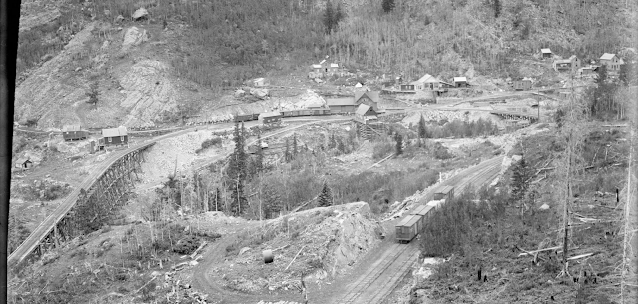 |
| In this cropped view taken from the Denver Public Library, it's easy to see how the Ophir Loop used trestle and curve, cut and fill to shoehorn a railroad through the deep canyons, climbing the San Juans of Colorado Photo: Thomas McKee |
Below, we find RGSrr.com's Route of the Rio Grande Southern. It shows with remarkable clarity, exactly where the railroad ran, how it worked with valleys and loops completed by curved trestles, fighting for every foot of altitude! It has a key that shows which trestles went where and which there are pictures for. It is an incredible resource for the narrow gauge modeler and railroad historian! ⚒
Sunday, October 1, 2023
Understanding Railroads - Railcars Explained in 15 Minutes
If you explore the rails in Colorado for any amount of time, you've likely found a railcar you've not paid any attention to before. Ever wonder why some boxcars have a generator on one end? What is a rotary dump gondola? Why can you feel heat coming off this tank car? By far, the most common question I still get from folks outside the railfan community is, "What happened to the caboose?" All of this is covered in YouTube channel Practical Engineering's video below.
While this video is not directly related to Colorado, nearly every railcar described I have seen in Colorado at one time or another, even the specialized "Schnabel" car. She is a brute, too! You never know what's going to wander down the rails these days. You might even see a 737 "fly" under a bridge!
 |
| A BNSF train passes under the new pedestrian bridge at Palmer Lake, Colorado on its way north on Father's Day 2023 carrying a number of narrow-body 737 fuselages for final assembly at Boeing Photo: Karen Walden |
I appreciate Practical Engineering putting out this video. His announcement of a deep dive into railroad engineering by a railfan certainly sounds promising.⚒
Wednesday, September 20, 2023
Rocky Mountaineer - Rockies to the Red Rocks of Moab
Something that railroads do much better than roads or airways is taking many people to a common destination while letting them see the country in which they're traveling. It combines the rugged beauty of driving with the ability to get up and stretch one's legs, interact with and meet more people than you would normally. We've lost touch with that. Luckily, the Rocky Mountaineer is giving those who can afford it a chance to travel from Denver to... wait, Moab? Let the RM make its case.
;
Jeb Brooks takes you on a 30 minute tour
I won't say this is a renewal of the Rio Grande Zephyr by any stretch. The RGZ was more old school passenger train than this train crew ever dreams about. Nonetheless, it is inspiring to see the Rocky Mountaineer opening up the western slope to those minds looking for something more than the next Ibiza or Parksville.⚒
Thursday, March 9, 2023
Thoughts On Don Phillips' Loss of Mobility
 |
| Pagosa Springs in October is pretty, but can you live there? // Milan Suvajac |
There, in July's issue, sandwiched between an ad for Erie Lackawanna VHS cassettes and an ad for FastTrack, a video magazine subscription that predated vlogging by a mere 20 years, was a column that could have been written yesterday. Don Phillips, for all his east coast swagger, nailed down a plight. This plight is both near to my heart and yet so far from a possible solution that will likely never see a resolution to my satisfaction. It is the plight of everyone who lives in Colorado's rural counties and towns.
"What?" say the rural denizens of Colorado. "We're okay." Yeah? Hand me your drivers license. Still ok? No, and why not? Because your four wheels (or sometimes two) are your ticket to American freedom. If you handed over your precious Colorado drivers licenses, you would be cut off from work, from home, from your leisure activities and your grocery store, pharmacy and your doctor when you are sick. Any trip in America and especially Colorado nearly always begins with the private vehicles we own.
We own vehicles? Not all of us. But let's consider: Cars are the required luxury. The essential option. The one thing everyone is free to decline at the peril of losing everything. If you have made it past 60, you know that your insurance premiums are rising and will rise until you eventually cannot afford them or you voluntarily surrender your life on four wheels. You either die before you reach that age or you must surrender your freedom. Oh, that will never happen to you.
Others have never driven a car, but most of us don't know them, couldn't relate to them, or actually ignore them. These are the people who know bus schedules, rely on programs and family members to care enough to meet their transportation needs. But try living near Springfield, Craig, Sterling, or Cortez without a license to
As we found out in 2020, being stuck at home is no fun. Telecommuting, even if you have great internet service, has its limitations. Even the American workplace, for good or for ill, is beginning to require attendance from their employees again. In fact, it's hardly a secret that most of rural America has been languishing since the 1950s. Even in periods of massive growth, such as the teens, multiple Colorado counties have experienced double-digit loss percentages. Why? I'm not sure, but I have a feeling that losing the local train has something to do with it.
The local train? Local train, as in not intercity, not hub-and-spoke, not long-distance. I won't re-say what Mr. Phillips skillfully wrote nearly 30 years ago now, but let me say that I sincerely believe he is right in this case. Please click or tap to view the article.


So, what do we do? Do we just click our tongues and click our mouses (or swipe or scroll) on to the next story? Or do we start thinking about the idea of making things local again? Do we make a point of shopping locally if we can. Heck, what about just trying to remember our neighbors' faces and names? What about remembering the checkout person at the store, or the cleaning person emptying the trash for us? Connecting locally can change everything, especially our living patterns.
I don't have an easy, ready-made solution in the offing for the small town shrink-down, but it all starts with a mindset. Just because it isn't "our problem" doesn't mean it's not worth our time and effort to fix. It needs our attention before the price of groceries goes any higher. Or did you think these problems weren't linked to yours? ⚒
* The collection is now obsolete, superseded by a deluxe subscription to the magazine, which allows online access to the entire back catalog of the magazine including the last 12+ years.
Thursday, October 27, 2022
Union Pacific Grade Crossing Accident Raises Eyebrows and Questions
This story has been all over the news outlets in Denver, and its reach has gone international, mostly for the shocking lack of common sense by all the officers involved. Police from Platteville and Ft Lupton, two small municipalities north of Denver, pulled over Yareni Rios-Gonzalez, a 20 year-old woman from Greeley. They executed a high-risk stop, got her handcuffed and placed her in the back of a police cruiser.
Less than 2 minutes later, a Union Pacific freight train broadsided the cruiser at 50 miles per hour. Rios-Gonzalez was still inside.
She survived, and her lawyer is suing the police departments responsible.
Like the expert of record here, most are dumbfounded by the negligence of the police officers. What is less clear are the factors that made the accident possible:
- Poor location - the officer conducting the stop could have signaled the driver to pull over later or had her move further away from the tracks
- Task saturation - All five of the officers were conducting a search of Rios-Gonzalez' vehicle and no one officer was in command of the overall scene
- The crossing was marked by crossbucks, but there were no signals or gates. Had there been, flashing lights and gates would have activated, potentially raising the alert in time for the officers
But all of these wouldn't have mattered if the one officer had followed a rule given to all motorists in the Colorado Drivers Handbook in section 11.5:

It's pretty hard to break two of the three bullet points in one maneuver, but the officer in question managed to find one instance where it's possible to do that. They managed to park on railroad tracks, and they were on a railroad crossing which is certainly within 30 feet. The tragedy is that this whole accident was something a 16 year-old driver could easily avoid by following the rules every driver living in Colorado is required to know and abide by.
Grade crossing safety is a clear lesson taught in handbooks, public service announcement ads, and campaigns like Operation Lifesaver, started 50 years ago this year by the very same Union Pacific. Like all instructions (and, incidentally, safety belts), they only work when applied. ⚒
PS: Since this was originally written, an officer was charged.
Sunday, September 18, 2022
San Luis & Rio Grande Railroad May Have A Buyer But Questions Remain
 |
| SL&RG 1744 steams eastward into the sunrise toward La Veta Pass Photo by Mike Danneman |
Another company, North Central Railcorp headed by Friends of the Cumbres & Toltec Scenic Railroad, Inc. President Tim Tennant, has indicated its interest to Roni Wisdom, Alamosa County Administrator, and should be working with the court and trustees, says Alamosa News.
Hopefully, in OmniTrax we have a clear winner. Even if we do, the possibility exists that if OmniTrax fails in the San Luis Valley, it could file to abandon the historic branch like it did recently. According to AlamosaNews.com,
On Aug. 9, 2019 – just three years after purchasing the line – OmniTrax and CTXR petitioned STB to abandon the line, citing the loss of millions of dollars in acquiring and operating the line and asserting the cost of continuing to maintain and operate the line far outweighed the potential revenue from shippers. STB approved the petition, and the line was abandoned.
That is not to say that the San Luis & Rio Grande Railroad would be in the same boat as the Central Texas and Colorado River (CTXR) Railroad, which was purchased by OmniTrax on the assumption demand for fracking sand would drive their railroad's profitability. When the demand didn't materialize in 2017, the railroad stalled. The San Luis & Rio Grande has the demand already in hand.
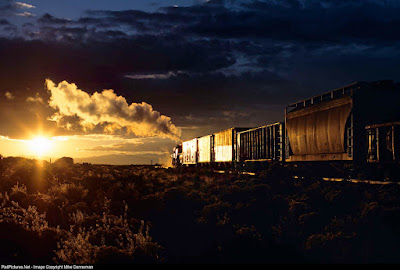 |
| The rising sun glints off the special photo freight of the SL&RG Photo by Mike Danneman |
On the other hand, one thing is certain: If SL&RG were to shut down for any reason, Coors' Rocky Mountain barley and other clients' products would be forced over La Veta Pass via US 160, and I know from personal experience the highway would never handle such a load without tens or hundreds of millions of dollars spent to improve it. Thus, the San Luis & Rio Grande Railroad had better keep those steel wheels rolling, whatever happens. We can't afford for it to stop. ⚒
Friday, September 2, 2022
POTD - Floating a K-37 Over the Animas At Tacoma
Today's Photo of the Day is by Kevin Madore, who a year ago today captured Durango and Silverton Narrow Gauge Railroad's oil-fired K-37 493 as it crossed the Rio de las Animas at the Tacoma bridge. The way Mr. Madore used his wide angle to shape the scene it makes the thousands of pounds of steam and steel seem to float, barely touching the bridge. I know that every bolt is feeling the the heaviest of the Rio Grande's narrow-gauge (actually a former standard-gauge!) engine as it rolls across it, but somehow the wide angle view and the elevation makes the engine seem to glide across!

In the right hands, photography is science and artistry coming together to create magic. Sometimes you can make the heaviest things float on air.⚒
Friday, May 13, 2022
Denver History Still Lives ...If You Know Where To Look

Without Coors Field, it's fair to say that businessmen and builders like former-Mayor-and-then-Governor John Hickenlooper would have had much more difficulty attracting investors and generating momentum for businesses and projects that got started or are now based out of lower downtown, LoDo to the locals. Without Coors Field, the renovation and redevelopment of Denver Union Station would probably never have happened. The FasTracks rail and transit project would have been more difficult to sell and Denver's suburbs would have been as isolated as they were in the 70s and 80s, and sprawling ever outward even more than they do today. LoDo is now synonymous with revitalized and reinvigorated urbanized living. The strong popularity of such a lifestyle has produced another re- adjective: regentrification. If you have lived anywhere in Colorado in the past 25 years, you have benefitted in some small way from this LoDo effect.
All of these "re-s" have effects both bad and good. What's also apparent is that the optimism keeps popping up and spawning new challenges and opportunities. For example, I was more than a little unnerved by the relentless construction and development. Was no one going to remember the railroads of downtown or the Moffat Road depot or the lines that ran through Auraria? The viaducts or the Postal Annex, the yellow-bricked monstrosity that sat south of Union Station is gone, hauled away in 2005. What of the Denver of before?
It may not be possible to preserve everything, but we can still build with an eye to our past as well as the future. The Oxford is still with us. Denver's Union Station has never stopped serving all passenger trains climbing and descending to the Mile High City, save for a renovation. The Union Pacific Freight Office persists (at least outside) as the Denver Chop House. But I shuddered when I saw construction barricades going up right next to it. This was hallowed ground. This was where Gen. William J. Palmer laid the first rails of his beloved Baby Road, the narrow gauge Denver and Rio Grande Railroad. What were they doing to this spot? I didn't have far to look: McGregor Square.
Yes, the west corner of the giant Colorado Rockies-built development is built right off the spot in the street where Palmer spiked his rails. So imagine my surprise when I found that one of the establishments in the complex is called "Milepost Zero!" No! I thought, This can't be! Do they really know? And although it does not mention the Denver & Rio Grande or its later incarnations by name, their site says the following:
In Denver’s early days, the railroad became the center of everything. Across the street from what is now Coors Field was where the tracks began – mile post zero. Today, McGregor Square sits in the center of everything Denver has to offer.
It all starts here. Welcome to Milepost Zero.
Milepost Zero is the simply great, convenient choice in Denver’s Ballpark neighborhood. Your home-base for shopping, dining, entertainment, gameday, exploration and everything in between, Milepost Zero serves up something for everyone in the family.
Explore the concepts in our food hall, grab a drink at the bar or pour yourself a beer from our extensive Beer Wall selections. No matter what you’re in the mood for, you can enjoy your favorites in our expansive indoor space or outdoor plaza at the heart of McGregor Square. Catch the game on our giant outdoor plaza screen or just watch the action in the square while you fuel up or wind down.
When I next visit Coors Field and hopefully watch a Rockies game, I plan to visit Milepost Zero and hopefully partake and imbibe. It's the least I could do for such a history-minded proprietorship, even if the prices are above and beyond what I would usually pay.⚒
Wednesday, April 13, 2022
Jim Wrinn, Passionate Advocate and Colorado Railfan, 61
 This is a post I'd rather not write. I will keep it brief.
Perhaps one of the greatest friends to the railroads of Colorado, indeed certainly to live outside of the state and within the last 30 years, has passed on March 30, 2022. Jim Wrinn, for 17 years Editor of Trains Magazine, had a long battle with pancreatic cancer before it stole him from our midst. I wish I could say this is the only friend I've lost to the monster, but I can't. It has the highest mortality rate of all the cancers, with a 5-year survival rate of just 11%, or 9 out of 10 diagnosed die within 5 years.
Yes we all die. Yes, I believe that something wondrous and glorious awaits only some of us. I believe I will see him again. That doesn't take away the pain of goodbye. And certainly not someone who was generous with his time and energy to someone like me. We weren't that close, but he made me feel a part of his world, and that counts for a lot for someone disabled.
Jim was no stranger to the Antonito, to Durango, to Denver, or many of the points around and between. He realized a hope at the Victorian Iron Horse Roundup (archive) by re-enacting a shot from Trains' long past covers only last year (above). Had COVID delayed it again, he wouldn't have lived to see it. I am personally gratified it did not and he did.
His obituary at Trains contains the following quote of Fred W. Frailey:
“Every writer wants an editor, a boss, who says yes, . . . Forget what ‘yes’ means — it can mean anything. Jim Wrinn always said ‘yes,’ even when it was no because he made it seem like yes. I love the guy.”
Adios, my friend. ⚒
Tuesday, January 18, 2022
Trains 1963: D&RGW 3600's Out of Minturn
Mention Rio Grande steam in railfan circles and immediately what comes to most minds? The diminutive narrow gauge steamers of the Cumbres and Toltec or Durango and Silverton. Few think of the main line steam giants of Challengers, cousins of recently retired UP 3985, or mallets with massive 40-inch low pressure drivers living on as class L-96s. Indeed, half of the steam legacy of the Rio Grande has vanished like water vapor on the Colorado wind. It is the most vivid reason steam preservation programs continue to endure 80 years after the zenith of steam. Provide the experience of the raw power and romantic beauty of steam and watch it fire young imaginations!
Yet we do have some signs of the passing of standard gauge Rio Grande steam. Photos of brawny giants reside in collections large and small. One of the largest remains the Denver Public Library Western History Collection. No less beloved are books like the Colorado Railroad Museum's Rio Grande Locomotives and Robert LaMassena's Denver & Rio Grande Western: Superpower Railroad of the Rockies published in 1999.
Perhaps the most meaningful are the personal accounts like that of John Hill and Dave Straight from 2015. More widely known is a much younger Robert LaMassena's account of the 3600s Out of Minturn published by Trains in 1963. Reproduced here by permission, he recalls the run over the Continental Divide with peaches from Grand Junction and Palisade. On a side note, Palisade peaches are one of the most wonderful parts of late summer in Colorado, second only to the fall colors. I can remember with perfect clarity my most recent ripe peach from Grand Junction in all its giant, sweet, juice dribbling glory! They are incredible! If you are here in late August or early September, do not miss your opportunity to eat your fair share.
To read in full resolution, tap or click the image to view it
D&RGW 3600s Out of Minturn
by Robert A. LaMassenaTrains magazine, April 1963


Finally, this article was reproduced from Trains 1940 - 2010, but for access to thousands of other articles published since October 1940 to today's issue, all you need to do is subscribe to Trains with an Unlimited subscription. I'm finding my own self-paid subscription to Trains unlimited very handy. ⚒
Monday, November 22, 2021
Last Light at Palmer Lake
Here is just a quick highlight of a photo that looks so nice it's worth sharing.
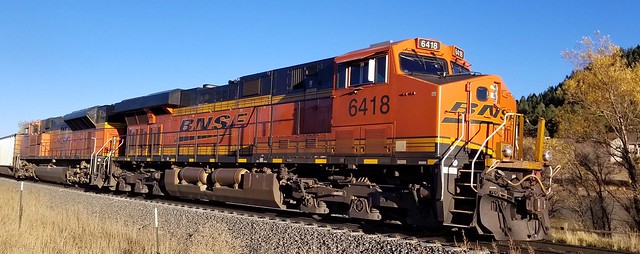
This photo of a BNSF GE unit at Palmer Lake is from Flickr user Bob, whose recent work on the Joint Line shows a good deal of promise. He shoots army tanks in the fog, too! If nothing else, his buying an SLR would not be wasted money! Great work, Bob! I hope to see more soon. ⚒
Sunday, October 17, 2021
A Non-Travel Vlogger Takes Amtrak's Southwest Chief

- What's with the holes in the tines of US plugs?
- Are extension cords more dangerous than we've been led to believe? Hint: yes! 🔌
- Are LED stop lights really that much better than incandescent? 🚦
- Why is High the first setting on most fans?
- Was VHS actually superior to Beta? Oooh, he's meddling in an old format war! 📼
Alec took a cross-country trip on Amtrak this past August and, being an Amtrak newbie, he splurged and bought a roomette ticket. He admits he's not a railfan or a travel blogger, so it's not like he has all sorts of tips and tricks. You can get those elsewhere, one might hope, anyway. His route was from Chicagoland to sunny San Diego by way of LA and the Southwest Chief.
En route, Alec posed some very interesting thoughts and--this is why I watch him folks!--he nailed one of the main reasons why long distance rail has struggled in America. Nevermind that passenger rail was usurped by an independence-minded but vastly inefficient technology like rubber tires-on-asphalt. Nevermind that Amtrak was never supposed to make money--he got that right too, however. He said essentially that while the cost of a sleeper ticket is mostly out of the range of most Americans, additionally, working people in the USA are too time-poor to be able to splurge 3-5 days on travel. If you want to make a trip to the east or west coast from Colorado, you book it through DIA and not DUS not because "getting there is not half the fun!" but because your damnable HR policy only gives you one weeks vacation the first three years, if you're lucky! That's not right, and we all know it.
The USA is not in an emergency. We are not even trying to beat the Russians to the moon--we're just trying to get there sometime soon. We're not even trying to keep someone else from subjugating the world, like we did in WW2. We are working ourselves to the bone and why? Our kids need us. Our families need us. Our lives need us. We last added a day to the weekend over a century ago and productivity soared! Doing that again isn't a terrible idea. Certainly adding some more time off would help.
I'm not saying we overturn society. I'm not advocating a shift to communism. I'm saying we need to give our employees time to live a life worthy of the effort of living. The rest of the world gives their employees a much more sane consideration. It's time we do too. Until we do, reasonable rail travel will continue to be a luxury and worse, society will continue to slide downhill. No, I am very serious.⚒
Further Reading:
- CNBC - How Far Behind America Is In Paid Time Off (2018)
- Workest - How Much is Average PTO in the U.S.? (2021)
- US Bureau of Labor and Statistics - Employer Costs for Employee Compensation by Region (2021)
Monday, July 26, 2021
Email Subscriber Notice
If you subscribe to Colorado Railroads by email, changes are coming. Our syndication is through Feedburner, once an independent company that, after being absorbed by Google, is scaling back its service to just an RSS service, without its helpful email administration. Blah blah blah, corporate-speak, technogargle technobabble blah.
What this means is that until I find an e-mail service, probably something like Constant Contact, further email contact from Colorado Railroads may be in doubt. If you like what content I've been able to provide and want to keep hearing from me, please let me know. That way, whatever happens, I will be sure to keep you in the list. Hit reply or click here. I hope to hear from you soon!⚒
Steve Walden
editor, Colorado Railroads
POTD - Big Boy Under Threatening Skies
 |
| Photo of the Day: BUFFIE |
Earlier this month, Union Pacific's Steam collective in Wyoming needed to stretch their Big Boy's legs before beginning their summer trip to New Orleans. A quiet trip to Denver seemed to be in order. Intrepid Denver-based rail photographer BUFFIE caught up with UP 4014 leaving Platteville on the trip back north to Cheyenne. The threatening skies and ideal lighting and classic black-and-white subject make it an easy candidate for Photo of the Day.⚒
Friday, May 14, 2021
Ask the Editor: Loops Like Tehachapi
It's been a while since we've done an Ask the Editor. Here's one from the e-mail bag, which lately has been overflowing.
Question
Last February, we had a chance to see the Tehachapi Loop in California. I'm told something similar is here in Colorado between I-70 near Wolcott and Steamboat Springs. How would I find it? Thanks, Ken Harris
Answer
Interesting! I think you might be referring to the loops near Bond.
It does not loop over itself, but it does use some significant grade and reversing loops to "cut the contours" or gain elevation. This was part of the Moffat Road beyond the Dotsero Cutoff, which was built by the Rio Grande after they bought up the Denver & Salt Lake Railroad as a means of shortening their Denver to Salt Lake City mileage.
If you hadn't prefaced it with the Wolcott to Steamboat location, I might have just assumed you were being pointed at the Georgetown Loop!⚒
Thursday, April 15, 2021
Commemorating the Denver & Rio Grande Railroad's 150th Anniversary
Over 150 years ago, on October 27, 1870, civil war General William Jackson Palmer and his associates filed papers incorporating his baby railroad in the territories of Colorado and New Mexico. Thus, on paper at least, the Rio Grande, a narrow-gauge startup of a railroad had been born. Any outward symbol of its birth, however, would have to wait while Palmer and his associates like William Bell raised investor funds to begin building.
 |
| Gen. William J. Palmer statue outside his namesake high school, August 1980 |
With General Palmer astride his iron steed in statue above Colorado Springs' main thoroughfare, it's easy to forget that this man wasn't yet 35 years old when he was working the difficult task of convincing investors to part with their funds to raise capital. General Palmer was a former spy, adept at making others believe he was in their confidence. Often the difference between this man and a shifty crook like Soapy Smith is simply the ultimate intentions of the man's heart, to deprive for selfish improvement or for benevolent investment.
Thankfully, Palmer was a man worthy of his Queen, a nickname Mary Lincoln Mellen had already earned by the time she met her future husband. Palmer began to share his vision for the Denver & Rio Grande with his beloved in their correspondence. On January 17, 1870, Palmer wrote to her,
I had a dream last evening while sitting in the gloaming at the car window. I mean a wide-awake dream. Shall I tell it to you?I thought how fine it would be to have a little railroad a few hundred miles in length, all under one's own control with one's friends, to have no jealousies and contests and differing policies, but to be able to carry out unimpeded and harmoniously one's views in regard to what ought and ought not to be done. In this ideal railroad all my friends should be interested, the most fitting men should be chosen for different positions, and all would work heartedly and unitedly towards the common end.

From there, he went on to detail an ambitious business plan with specific men to fill out all the critical functions of a railroad, informed by his work experience laying the route of the Kansas Pacific to Denver. Whatever idealism he held from that nearly rapturous dream, it obviously fueled his efforts for the next 18 months until driving the first spike for the Denver & Rio Grande Railroad on July 28, 1871 between 19th and 20th Streets in Denver, much in line with Wynkoop. This places it right next to the Chop House Brewery (the former Union Pacific freight offices) near Coors Field in LoDo.
Dreams, like buildings, take a long time to build to make them last. Foundations are critical, and yet none but a few will ever see what the entire building and the day's occupants completely rely upon. Be thankful for the diligent yet incredible work of Palmer and those like him, founding the Rio Grande and the city of Colorado Springs, while these two entities, changing and growing and enduring all the while, still sustain Colorado and the west today.⚒
Sunday, January 24, 2021
Suits Filed Anticipating Tennessee Pass Activation
Well, that didn't take long.
Proving that there is nothing new under the sun, the action announced on the 31st of December, 2020, Rio Grande Pacific To Lease Tennessee Pass Route, became the subject of at least two separate suits filed by lawyers whose interest in what's best for Colorado is dubious at best. The Union Pacific and Rio Grande Pacific most likely expected this knee-jerk reaction.
The Town of Avon and Eagle County have both agreed to split the cost of a challenge filed with the Surface Transportation Board (STB). Apparently, the occupants of the town and county are already convinced that the rails are mere days away from coursing with crude oil. The idea that the company doesn't want to haul crude and instead haul other freight and possibly provide a commuter service to towns along the line like the one they already conduct in Texas seems to fall on deaf ears.

The STB is limited in what it can and can't decide. According to the Colorado Sun,
Michael Booth, a spokesman for the Surface Transportation Board, said the board operates like a court, with strict parameters for approving or rejecting rail plans. The board’s goal is to insure [sic] rail traffic rolls smoothly and that competitive issues are resolved, Booth said. It doesn’t have a lot of leeway for rejecting plans by an operator who promises to fix up a critical corridor that has been neglected for decades.
“We have limited jurisdiction to decide economic regulatory affairs,” Booth said. “The board’s concern is mainly, ‘Does the line serve a public purpose?’”
The Colorado Sun article continues,
Before trains roll over Tennessee Pass, there will be much more review and studies by a host of local, state and regional authorities, including the Forest Service and Colorado Department of Transportation. The transportation board is a first step in what will be a long process.
The length of time reactivating this line is something that all parties must be prepared for. It is going to take some time to understand what activating the line means and doesn't mean for everyone involved. Pueblo alone will find its future a little brighter by becoming a junction again and not merely a stop on the Front Range.
More importantly, if the Tennessee Pass route is rehabilitated, it will be updated and upgraded with Positive Train Control, a much safer means of controlling rail movements than the CTC-based approach that was in place in 1997 when the line was inactivated.⚒
Thursday, December 31, 2020
Rio Grande Pacific To Lease Tennessee Pass Route
One last post to close out 2020. And boy, is it big news!
A group known as Rio Grande Pacific is going to lease the Tennessee Pass Route from Union Pacific. Both Trains and Railfan & Railroad announced the news today.

Railfan & Railroad stated,
According to a press release, Rio Grande Pacific subsidiary, Colorado Midland & Pacific Railway (CMP), will lease a majority of the line and file for common-carrier authority with the U.S. Surface Transportation Board to operate it. Officials said that CMP will “assess the interest of the communities served by the Tennessee Pass line” for both freight and passenger service.
Trains followed with more details from the STB filing:
The Colorado Midland & Pacific filing to the STB says the railroad will lease 163.1 miles of the line between milepost 171.9 at Parkdale, Colo., and Milepost 335.0 near Sage, Colo., and that it projects the railroad’s annual revenue will not exceed $5 million. The portion of the line east of Parkdale is currently operated by short line Rock & Rail, and also hosts the Royal Gorge Route Railroad tourist operation.
Rio Grande Pacific is based out of Benbrook, a suburb of Ft. Worth, Texas.
With no traffic over the railroad for over 20 years now, my guess is that at least three months are going to be spent rehabilitating the line. The line has been stripped of most of its copper and any other valuable metals by vandals during the gap in operations. It's more likely, with the new PTC standards, that the entire line will be rewired.
Questions about passenger service and other meaningful commodities still need to be assessed by the new company, but their associated transit company would certainly be involved. Commuter service to Dowd Junction for Vail would certainly bring a great deal of help for those who work in the ski industry and the associated services like food and hospitality. It may eventually even raise property values all along the line to accommodate those workers. The Vail news site Real Vail has more on these contingencies.
Stay tuned!⚒
Subscribe to:
Comments (Atom)